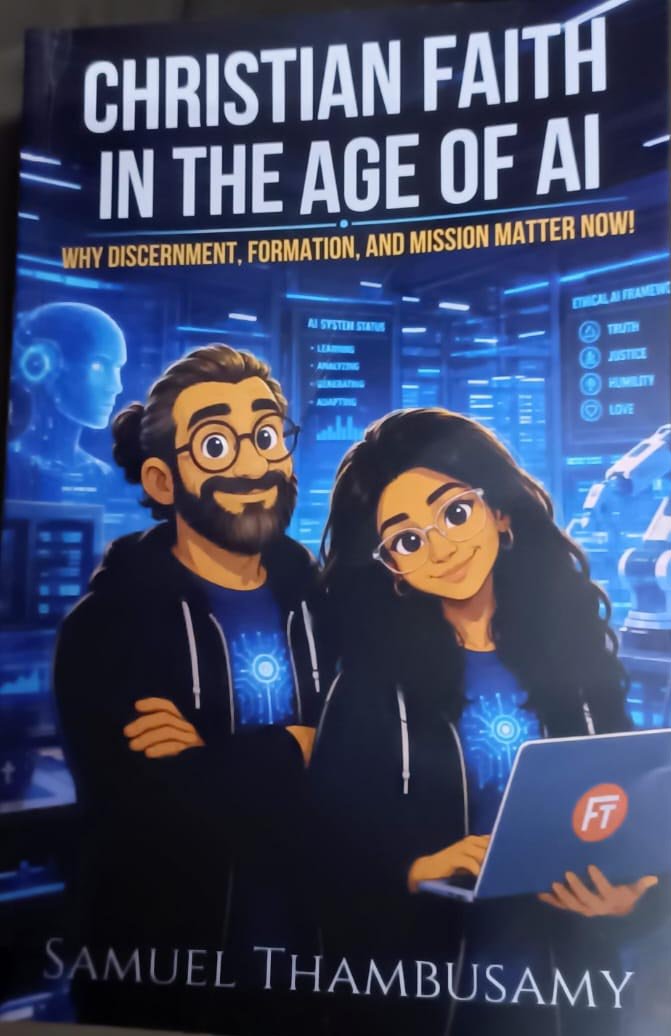
Christian Faith in the Age of AI: Why Discernment, Formation, and Mission Matter Now
Author: Samuel Thambusamy
Publisher: Future Tense Publishing
Place of Publication: Bangalore
Year of Publication: 2026
Reviewed by: J.N. Manokaran
Samuel Thambusamy has written a timely and thought-provoking book that addresses one of the most pressing issues of our era: the relationship between Christian faith and artificial intelligence. Known for interpreting contemporary culture through a biblical lens, the author provides much-needed theological clarity for Christians seeking to engage faithfully in a digital world increasingly shaped by AI. As artificial intelligence influences business, education, healthcare, government, and daily life, believers need wisdom and discernment to navigate this emerging landscape.
AI as a Formative Challenge
Thambusamy argues that AI should not merely be viewed as a technological innovation or an economic force. Rather, it represents a formative cultural moment that is reshaping how people act, react, trust, decide, and envision the future. He reminds readers that the Church has successfully navigated previous technological revolutions without compromising its commitment to biblical truth:
“Yet this technological shift is not new territory for theology. The printing press reshaped Scripture and authority. Industrialization reshaped work and vocation. The internet reshaped community and truth” (p. 6).
Instead of responding with panic or uncritical enthusiasm, Christians are called to practice slower thinking, deeper reflection, and faithful discipleship.
A Test of Faith, Not a Threat
One of the book’s most significant insights is the distinction between a threat and a test:
“AI does not threaten the heart of Christian faith. But it does test its depth” (p. 9).
The challenge facing the Church is ensuring that wisdom survives the age of speed, that genuine human presence withstands digital abstraction, and that Christian hope remains grounded in God rather than technological progress.
Imitation Is Not Intelligence
The author carefully explains how AI functions:
“AI works by recognizing patterns in large amounts of data. It can sound intelligent, but it does not think, feel, or take responsibility. It produces responses based on probability, not wisdom” (p. 11).
AI is more than a tool; it is becoming an environment that increasingly shapes human interaction. Thambusamy traces the evolution of AI from traditional programming to machine learning, emphasizing that modern AI is driven more by statistics than logic, and more by probability than certainty. He also provides accessible explanations of Generative AI, Agentic AI, and Artificial Superintelligence (ASI), reminding readers that ASI remains speculative. Christian hope, therefore, should never be surrendered to hypothetical machines.
The Five Layers of AI
Using the metaphor of peeling an onion, the author explains five layers of artificial intelligence:
- Data – What AI is fed.
- Models – How patterns are learned.
- Training – How systems improve.
- Intelligence – When AI appears smart.
- Applications – Where AI impacts daily life.
AI knows the world only through data traces gathered and organized by humans. It mirrors human language but does not understand meaning. Its training may improve performance, but it cannot shape character. As the author observes:
“AI does not know that it knows. It does not choose. It does not bear responsibility” (p. 29).
Human intelligence, unlike artificial intelligence, is moral, relational, and accountable.
Humanity and Creation
The book places AI within the broader framework of creation theology. Human beings possess a divine calling and responsibility as image-bearers of God. AI, however, is a product of human culture; it is neither alive nor part of God’s covenant relationship with humanity. The image of God is not found in intelligence or problem-solving ability, but in humanity’s relationship with God.
AI cannot repent, obey, worship, or love. Consequently, it should never be regarded as equivalent to human beings in dignity or purpose.
Wisdom Cannot Be Automated
A recurring theme throughout the book is the distinction between knowledge and wisdom. Thambusamy writes:
“Knowledge can be accumulated. Wisdom must be formed. Wisdom grows through reverence, patience, suffering, and obedience” (p. 39).
While AI excels at gathering and processing information, wisdom remains a uniquely human and spiritual pursuit. Biblical wisdom is learned through faithful living and cannot be generated by algorithms.
AI as an Environment
The author warns that technology is never neutral:
“AI increasingly functions not simply as a tool, but as an environment. It filters information before we see it. It recommends, ranks, predicts, and nudges” (p. 46).
As AI systems increasingly influence attention, decision-making, and behavior, Christians must resist allowing technology to redefine human worth according to productivity, efficiency, or output. Human dignity remains rooted in God’s design and purpose.
Knowledge, Authority, and Discernment
In the digital age, knowledge arrives instantly, confidently, and conveniently. Yet theological authority requires more than information. Scripture links authority to character, wisdom, and responsibility. Trust cannot simply be transferred from relationships to technological systems.
Drawing parallels with the Tower of Babel, the author cautions against technological pride that seeks progress without humility. Such confidence always risks divine judgment.
Similarly, AI’s influence often operates subtly:
“AI does not usually command; it recommends, ranks and nudges” (pp. 55-56).
These seemingly small influences accumulate over time and gradually shape human judgment and behavior. Biblical discernment, therefore, becomes essential.
Formation in an AI-Shaped World
Formation occupies a central place in the book:
“We become who we are through habits, rhythms, and practices” (p. 63).
Human beings are shaped by stories, communities, and repeated practices. If the Church neglects discipleship and formation, secular forces will inevitably fill the vacuum.
The contrast between AI and Christianity is especially striking. AI is disembodied; Christian faith is embodied. God redeems people, not ideas. Christian formation aims at holiness expressed through faithfulness, humility, patience, and love. Thus formation becomes both faithful resistance and faithful action.
Ethics and Mission
The ethical challenges of AI are complex and far-reaching. Systems often reflect the priorities of those who design them, while vulnerable communities bear unintended consequences. Thambusamy argues that ethical faithfulness may require saying no:
“Refusal to deploy certain systems. Refusal to normalize surveillance. Refusal to prioritize speed over care” (p. 77).
The Church’s mission is not to compete with better algorithms but to demonstrate faithful witness through faithful living.
Importantly, AI does not cancel the mission of the Church. Christian mission remains rooted in truth, integrity, humility, repentance, and love. While technology promises salvation through progress, Christian hope rests solely on God’s faithfulness. In a culture of communication without communion, the Church embodies authentic community.
The model for mission remains Christ crucified. Digital culture often promotes self-display, while Christian mission calls believers to self-giving love.
Sabbath, Silence, and Attention
One of the book’s most practical contributions is its treatment of Sabbath and silence. AI never rests, making Sabbath a radical and countercultural practice.
Silence becomes a spiritual discipline amid constant notifications, prompts, and digital noise. It is not an absence of activity but an intentional attentiveness to God. Prayer, Scripture, worship, and fellowship retrain believers to direct their attention toward God rather than digital consumption.
As the author aptly notes:
“Attention becomes an expression of devotion rather than consumption” (p. 91).
The Future of Faith
Thambusamy concludes with a hopeful vision:
“The future of faith will not be decided by software. It will be shaped by leaders, teachers, pastors, and communities who know what must never be surrendered” (p. 97).
While AI may assist with sermon preparation, research, and administration, it cannot shepherd souls or nurture spiritual maturity. Churches must become communities where people learn how to think biblically, wrestle with Scripture, and cultivate wisdom through prayerful reflection.
Digital Strategy Without Digital Surrender
The author advocates a thoughtful digital strategy grounded in theological conviction:
“Strategy and theology must remain together. Without theological depth, strategy becomes imitation” (p. 101).
He recommends teaching children to:
- Pray before they prompt.
- Read before they summarize.
- Discern before they share.
- Gather before they withdraw.
In a culture characterized by acceleration, noise, and optimization, the Church must remain steady, attentive, and faithful.
Conclusion Formed, Not Replaced
The book culminates in a powerful warning:
“The danger is not that machines will replace humans. It is that humans will reshape themselves in the image of their machines” (p. 110).
This statement captures the central burden of the book. AI is not humanity’s rival; it is humanity’s creation. The real challenge lies in preserving biblical identity, wisdom, and discipleship amid rapid technological change.
Final Assessment
Christian Faith in the Age of AI is an accessible and insightful introduction to one of the defining issues of the twenty-first century. Written with theological depth, pastoral sensitivity, and cultural awareness, it equips readers to engage AI without fear and without surrendering biblical convictions. This book is especially valuable for pastors, church leaders, parents, educators, missionaries, and thoughtful Christians who want to understand the opportunities and challenges AI presents.
For those who are alarmed by artificial intelligence, concerned about the next generation, or simply uncertain about how to think biblically about technology, this book provides a faithful and balanced guide. It deserves a wide readership within the global Church.