
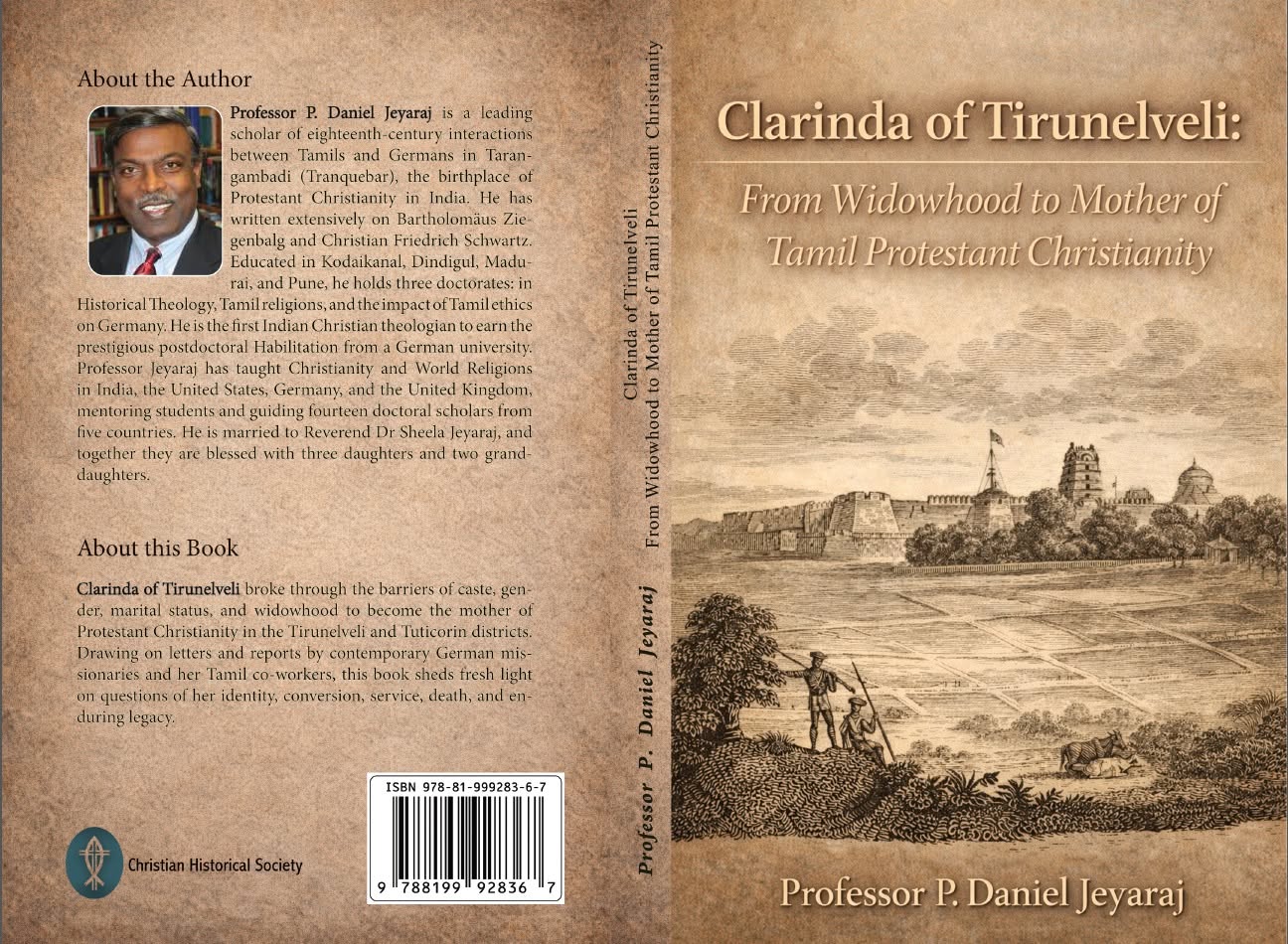
Clarinda of Tirunelveli: From Widowhood to Mother of Tamil Protestant Christianity
Name of the Book: Clarinda of Tirunelveli: From Widowhood to Mother of Tamil Protestant Christianity
Author: P. Daniel Jeyaraj
Publisher: Christian Historical Society
Place of publication: Surandai
Year of publication: 2026
Reviewed by: J.N. Manokaran
Professor Daniel Jeyaraj has portrayed the life of Clarinda with historical details, interpreting her life with missiological insights, and assessing her legacy in this remarkable book. Clarinda refused to be a victim of widowhood but became the Mother of Tamil Protestant Christianity.
Historical background
Clarinda lived at the intersection of culture in a complex world: Maratha royal traditions, Tamil social structures, European colonial presence, and Lutheran missionary networks. She was shaped by three aspects: Tamil and Marathi norms, biblical narratives, and Anglican and Lutheran interpretations of biblical narratives.
Status of women
Duties of a wife: 1) serve her husband without regard for her own life; 2) accept everything that her husband does, even if he sells her to others; 3) she should obey her husband even if it contradicts other religious duties. Some Tamil women also committed sati when her husband died. Such women were given deity status, and temples were erected, named as: Temple of the Mother, who sprang into fire.
Concubines
Concubines had a legal status inferior to that of a wife. “Concubinage has often functioned as a tolerated but morally ambivalent institution, existing alongside formal marriage.” (Page 33) Five types of concubines: 1) courtesans, as professional entertainers. Socially visible and respected; 2) Professionally, ritually, and musically trained temple dancers. Marriage-like relationship with patrons, and sexually exploited; 3) secondary household, not legally married. 4) Morally disapproved, illicit and adulterous relationships; 5) Suppressed Legality, paramour gives to his concubine a fee. The authors gives examples of concubines in the Bible: “All these concubines were within the household but outside the covenantal line through which inheritance and dynastic succession were traced.” (Page 39)
Clarinda as a concubine
Clarinda was an inheritor of the Maratha kingship of Tanjore, and a queen or head of a Tamil village: this headman would protect the local religious institution. Many Company employees were alone and could not bring families, hence engaged in sexual relationships through prostitution or concubinage with Indian women. Clarinda formed a relationship with an Englishman who was an Anglican. Clarinda interpreted her own relationship with the English officer not as a moral fall, but as a socially intelligible and culturally familiar role, especially among young Brahmin widows with limited options. She was Colonel Lyttleton’s mistress between 1765 and 1773. When he died, her second widowhood intensified her vulnerability.
Christian faith
She became familiar with the Thirty-Nine Articles of Religion, the Apostles’ Creed, the Nicene Creed, the Book of Common Prayer and other aspects of Anglicanism from Colonel Lyttleton. Though she sought baptism, it was not given as the marriage was not accepted. After her husband’s death, in March 1778 she received baptism from Schwartz and took the name Clarinda (according to some legends, her name of Kohila before). Clarinda resembled the Samaritan woman and Lydia of the Bible.
Ministry and Mission of Clarinda
She turned her home into a place of encounter, proclamation, and crossing of caste. Her work was proactive, strategic, theologically significant, and reformatory. Schwartz trusted his catechists and valued Clarinda’s leadership. In 1795, Clarinda’s congregation had 100 communicant members according to Schwartz. She is described as a gifted, generous, and socially elevated personality. Clarida led church emerges as Bible-centered, Tamil-led, Tamil-taught, and Tamil-shaped. It was a community that acknowledged human frailty, believed in transformation, practiced forgiveness, and promoted emotional honesty.
Though some mission records omit her name, mentioning just as a lady or Brahmin woman, it pointed towards her. The author adds: “Missiologically, Clarinda emerges not simply as a convert but as an indigenous missionary. Her life illustrates the dynamic interplay between the Gospel on the one hand and culture and local agency on the other. She asserted her leadership abilities and applied her Christian faith to local needs. Her courage and missionary endeavour continued to expand.” (page 71)
Mentorship of Christian Friedrich Schwarz (1726–1798)
Schwartz mentored, encouraged and affirmed Clarinda. Rebuking and guiding her when necessary. He trained catechists to love the Tamil people, engage with them in thoughtful, contextual preaching and discussion, desire their salvation, understand their culture, and lead a life which fellow non-Christians would respect. The wives of Catechists exhibited spiritual agency, hospitality, teaching, and generosity, thus, they shaped the next generation of Christians. Rural congregants thrived under local leaders and, with self-created devotional rhythms, could survive without constant missionary oversight. Tamil Christians were not passive recipients of missionary work but active agents who shaped Christianity in their own regions. They upheld the importance of reading books and taught the children to read as well. The result was a locally generated intellectual culture that valued critical thinking, leadership, and collective identity.
Continuation of mission
Sattiyanatan succeeded and led Clarinda’s church that provided a model for all other congregations that were connected to this mother church. Due to changes in Europe, all Danish properties were acquired by the British. The Lutheran churches became Anglican churches. The Anglicans did not fully acknowledge the contribution of Lutheran missionaries from 1706 to the 1830s. “Clarinda belonged to the first generation of Tamil Lutherans, long before Anglican structure took root in Tirunelveli.” (Page 165) Anglicans inherited the spiritual foundation that Clarinda laid.
The institutions she established: church and schools, the well, the Christian settlements, care for the poor, … continue to shape Christianity. The grant she provided to build the first church – like a mustard seed- has overshadowed Tirunelveli.
Woman of faith
Clarinda transformed vulnerability to strength as she refused to be silenced by stigma and discerned God’s call amid adversity. She is a great Model of Christian womanhood to demonstrate how the Power of faith can transform identity. “Clarinda refused to be defined by human loss, socio-religious shame and stigma. Instead, she interpreted her life through the biblical stories she had learned: stories of widows, concubines, and forgiven women who found dignity, purpose, divine favour, and a new life to God’s glory, one’s own joy and fulfilment, and for the blessing of others.” (Page 179)
Mother of Protestant Christianity
She was a leader with a global outlook. “Clarinda remains a mother of the Christian community in and beyond Palaiyamkottai, a woman whose life continues to inspire across denominational, cultural and regional lines.” (Page 181) She inspired future generations. “Some of her ‘children’ surpassed her to reach and impact, yet they continued to celebrate her courage, generosity and leadership. Clarinda’s legacy now endures across cultures, denominations, and nations.”(Page 182)
Conclusion
As a historian, Daniel Jeyaraj has woven a big-picture embroidery, providing historical context, cultural perspectives of that period, political environment, and social norms, with missionaries’ endeavours of Schwartz and his team of missionaries, and catechists. All information and facts are well researched and documented. The author’s biblical perspective and missiological insights provide rare clarity and appreciation needed for her work in the challenging context and times. An excellent book to be read by all Christians, a reference book for historians, and a treasure for all women.