A Shudra Life by Kancha Ilaiah Shepherd
- Author
- Kancha Ilaiah Shepherd
- Published
- Southside Books, Hyderabad · 2026
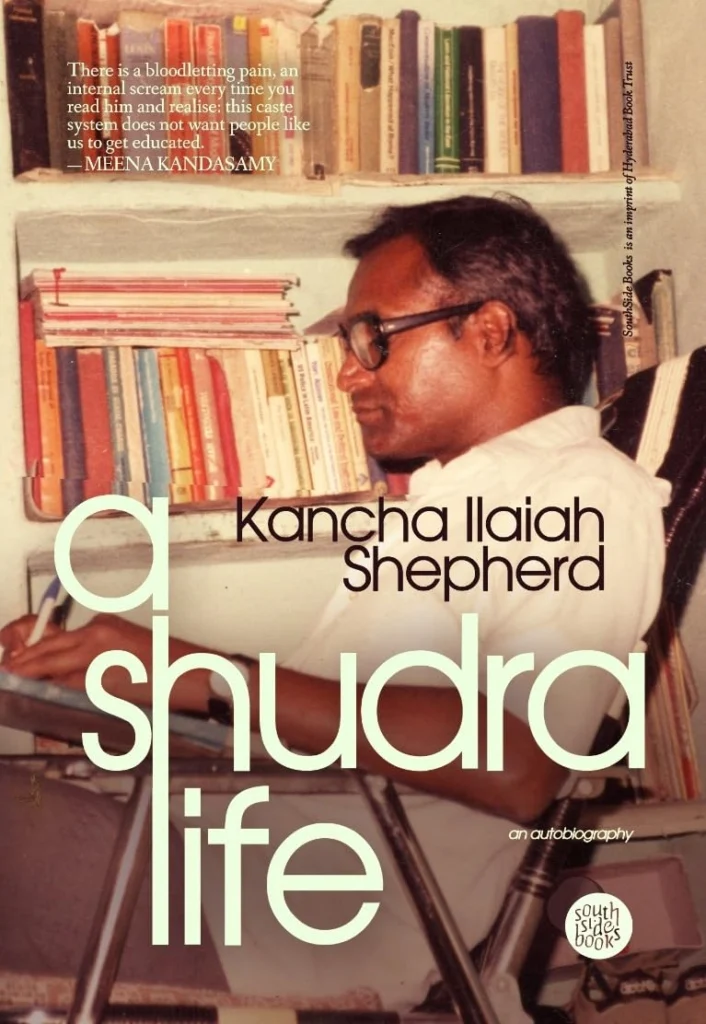
“The story of an individual is also the story of a society.”
Name of the book: A Shudra Life: An Autobiography
Author: Kancha Ilaiah Shepherd
Publisher: Southside Books
Place of publication: Hyderabad
Year of publication: 2026
Reviewed by: J.N. Manokaran
Kancha Ilaiah is a well-known civil activist, contemporary philosopher, and a popular writer. Though he belongs to the shepherding caste, an other backward caste, he is known as a Dalit intellectual.
Biography
He opines that only a few people from dominant castes have written biographies. People belonging to Dalit, Adivasi and Shudra communities write their own biographies, culture, religious beliefs or social life. He captures the importance of biography: “The story of an individual is also the story of a society. My narrative attempts to convey a particular historical moment-its patterns of living, its pleasures and pains.” (Page 6)
What is in the name?
The name Ilaiah is the name of his village deity. It is a theophoric name which is meant to both invoke and display the protection of the deity. There is a spiritual dimension to most names coming from this geographical region. When studying in college, many students from marginalized communities changed their names to resemble the names of the dominant community. Such people's names are not indicative of positive values; the name indicates violence.
Worthless name?
Names like Ilaiah are worthless names, given by worthless parents, and become worthless in our own eyes, and rendered history-less. The author was depressed and at the same time angry with the deities who were the source of such unworthy names. “But people with high-caste names routinely refused to respect them, they were known as gods of dirty people, their bodies smelt of sheep and they looked like buffaloes. Name, colour and caste were the source of respect and social status, not character, behaviour and knowledge.” (Page 16) “The whole cultural context of what is a ‘good name’ or ‘bad name’ or a ‘great name’ became the bane of my existence.” (Page 16)
Became proud of my name
In the Osmania University library, the author saw a book by Isaiah Berlin. He misread that as Ilaiah instead of Isaiah. Then he boldly wrote his name as Ilaiah Kancha – like some famous historian, philosopher, and thinker. The author discovered that the Bible has several names: Isaiah, Nehemiah, Jeremiah, Zephaniah, Zachariah. “It forced me to get into the furrow of an unwritten history of the humiliated communities.” (Page 19) He became grateful to illiterate parents who gave him a name similar to that of the great Israelite prophet.
Village life
Due to plague, grandparents migrated and formed a new village: Papaiahpet – 55 km from Warangal. The author provides a panoramic view of his early life in villages. “Our family histories revolved around sheep, goats, buffaloes, the terrain that we lived on, and also the deities that we worshipped.” (Page 8) They lived in small huts. They used wooden cots with thin ropes. In the village, the water was salty, filtered using thick cloth, and drunk. The village economy was self-sufficient, but primitive.
Shepherds
He belongs to the shepherding community. In his caste, men died early. Widows, if young, were remarried. Widows who have two-three children did not marry but lived with their in-laws. The death of men was due to the work in open country and forests. All women worked in the fields.
Food
They ate rice and jowar, though jowar was considered poor people’s food. They were non-vegetarians. “Diwali is the only day we did not cook meat or chicken.” (Page 9) Mutton was an important food, and he was given brains, which was perhaps the reason for his good memory. “The palm and eetha kallu available in this region seem to be good for human health, particularly when consumed fresh from the tree, and in limited quantities.” (Page 11) Fresh fish was washed with unpurified salt to clean and remove the odour from the fish. “To me, the Brahminic vegetarian dishes are nothing in comparison with our food.” (Page 12) The author wonders why every woman knows how to cook fish, and unfortunately why men know only how to eat.
Local gods
According to the author, though Krishna was a cattle herder, he did not accept the control of Brahmins and instead declared himself God. But in his village, cattle gods were Beerappa and Mallaiah. Their home goddess was Gouramma, who lived in a small separate room on a slightly raised earthen platform in the form of a turmeric ball.
Marginalized people
The author writes about the plight of marginalized people. They are the people who produce, but their knowledge of production is not considered true ‘knowledge.’ Teachers called students from those communities culturally backward. Even when his marks increased, it did not elevate his status.
Reading and Writing
Despite an unfavourable environment, he continued his focus on reading and writing.
Observations as a shepherd
“Sheep get easily sick in the rainy season. The sheep need to eat grass while moving. Sheep need more time to feed themselves compared to big animals like cows, bulls and buffaloes. The breed of goats my family and community had in those days was plant-eating, not grass-eating.” (Page 23) Shepherds eat the meat of dead sheep and even goats. The newborn lambs need to be carried for a day. They respect three types of trees: neem, banyan, and tamarind, as they were shelters in the forest. “Shepherds do not live like saints or rishis without any economic activity. They do not beg for food or grain.” (Page 25) Labour and common sense were the bedrock of my community. The plant-based medical system for the flock was known to shepherds. “A shepherd is trained to withstand rain, thunder, hot summers and cold winters.” (Page 162)
Caste as bane for the nation
“Caste fragmentation, untouchability and forced illiteracy among all the Shudra castes kept the whole village so backward and underdeveloped that even among the most brilliant brains, there was no imagination that went beyond their horizons. This imagination was experience-based.” (Page 27) Brahmins as priests entered their lives much later. “The baniyas treated not only the Dalits as untouchable, but also the Shudras. The marginalized were fearful of dominating castes who would humiliate and ill-treat them, subjecting them to all kinds of exploitation. The damage of the caste system extended to every aspect of life in India. “From childhood onwards, it is the mother who teaches the children how to follow caste segregation and why such segregation is important. The father creates the environment, and the mother injects the values.” (Page 124) The caste system has weakened the nation and the human essence in this country. The dominant castes treated others – Dalits, Adivasis, and Shudras as intellectually incapable. Treated them as second-rate people intellectually. “The Indian dominant caste diaspora had hidden the worst side of India from the eyes and ears of the rest of the world.” (Page 173)
Broken education system
The landlords established a school but ensured that no teacher taught there. “Their firm belief was that if village children began to go to school, no farm workers would be available in the villages.” (Page 38) In their caste, they believed going to school meant being killed by a goddess of education.
Early education
Since his parents were illiterate, the teacher randomly wrote his date of birth. He felt like a frog jumping from wide fields and cattle to a small well in a school. The school took away his freedom and made him a pupil instead of a master of his life. School also took away the fun, fear, and ecstasy.
Misunderstanding about education
There were many superstitious ideas regarding education. Reading heated up brains and spoiled the eyes. Studying makes the brain boil, and hence there is a need to have an oil head bath on Sundays. Though there was opposition from among his family members, he continued to study.
Love for English
English became his favourite language. One of the reasons was that it had just 26 letters. He proposes that all Indian languages could be written with the Roman script in India. Reading English was a lustful act. He learnt English from listening to the radio and from teachers in the classrooms. Reading English helped him to have a universal mode of thinking. Mother tongue nationalism is only for marginalized caste people. Good education is important; that too, English education is important. “I think a day will come where all Indians speak to each other in the English language.” (Page 185)
Refusal of humiliating rituals
“For the first time, we had taken our mother, who was still alive, to a place called the hospital, paid money for her to die there, and brought her dead body back.” (Page 66) There was a ritual in which the son should prostrate before a Brahmin priest. He refused to do that, despite pleading from the relatives. That increased his resolve to study.
Reformer, educate and organize
Mahatma Phule, Iyothee Thass, Periyar E V Ramasamy, and Narayana Guru did a lot, but Ambedkar came up as a force to reckon with in the academic environment. “With the deployment of language through the lens of caste, my worldview of social science changed.” (Page 93) Radical ideas of Marx were impracticable. The upper castes who were with that ideology became anti-reservationist after Mandal.
Teaching and Research
The author chose a middle path and was a hardworking student. When memories fail, history ceases to exist. Hence, he focused on teaching, research, and writing. Though he wanted to marry, girls liked his brains and not his body.
Intellectual children
The author considers his intellectual children to be his books. When he joined teaching, there was a trendy question: Can Ilaiahs teach in a university? He replied: “When we have taught sheep, teaching human beings is not at all difficult.” (Page 108) In the 1990s, at Osmania University, there was a slogan: “We shall not learn from a Dalit.” (Page 124) His book, Why I am not a Hindu, reached wider circles.
Indian philosophy?
“The books written by dominant caste historians were only about themselves and their philosophy. Treating their philosophy as Indian philosophy is a crime, in my view.” (Page 129) Historically, the Brahmin-Baniya community evolved a knack of constructing intellectuals (writers, musicians, artists) and promoted them to preserve its own hegemony. “Education means reading a story of war in Sanskrit, like the Ramayana and Mahabharata. The birth and death of humans and animals were not seen as worthy subjects of Indian education.” (Page 163)
Civil Rights
Ideas of civil rights were communicated in English in the classrooms, while in Telugu through civil liberties forums. Civil rights activism in India was by and large an elite one. Caste discrimination as a violation of human rights is not accepted by civil liberties movements.
My experiments with untruth
“Truth for a baniya like Gandhi, a brahmin like Radhakrishnan and a Kayastha like Chaudhuri is different from that of a Shudra OBC like me.” (Page 157) According to Gandhi, when he ate goat, it cried in his stomach. It never did so in the author’s stomach; it got digested. Mahatma Gandhi propagated regional language education for all, but all his descendants studied in English-medium schools. Why should OBC, Dalit and Adivasi follow that code of Gandhi?
Religion
Religion should not promote superstitions. “Congregative culture promotes common eating as against caste culture.” (Page 169) The Bhakti movement was the Hinduization of Dalits and not a liberation movement.
Constitutional framework
“The British Empire was useful for the marginalized castes more so for Dalits, because that empire had placed a constitutional framework in place.” (Page 181)
Death and afterlife
“My soul, perhaps, will remain with god in whom Gautam Buddha did not believe, but I believe in a force of eternity. I am convinced by the teaching of Jesus.” (Page 187) He wants his body to be buried to become part of fossil history.
Conclusion
It is a good book worth reading for those who love India and all people. It gives insights into rural life, the transition from village to town, the journey from an illiterate family to becoming an intellectual, and also the social and political times. It is a remarkable journey of life, an intellectual pursuit, and an attempt to make sense of the purpose of life.