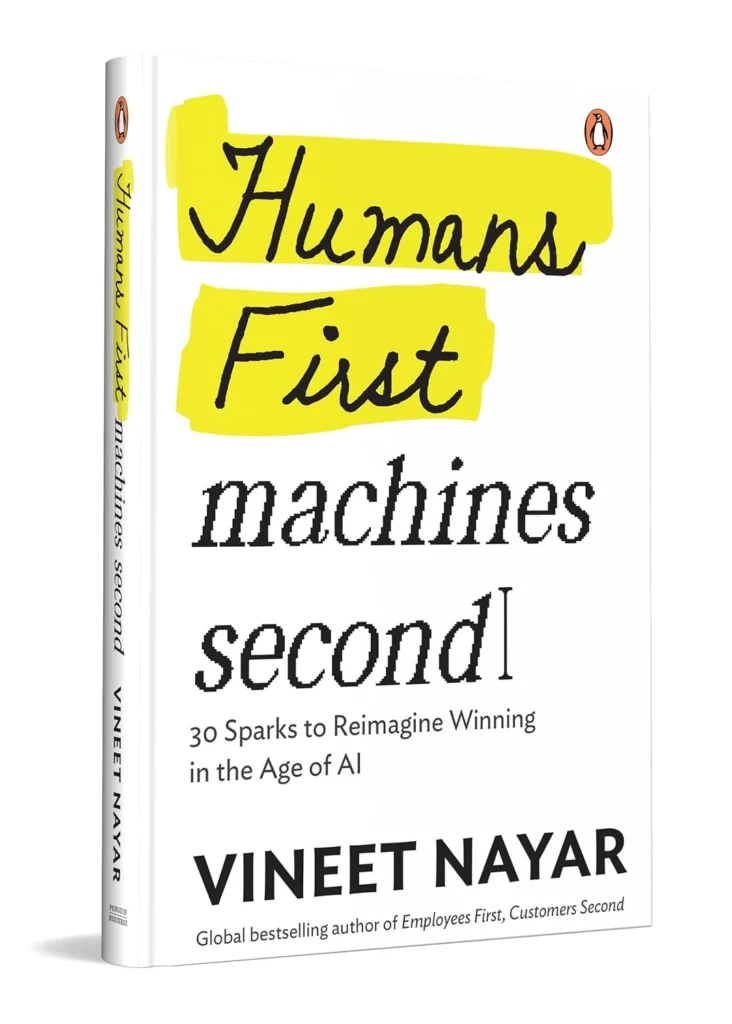
Humans First, Machines Second by Vineet Nayar
- Author
- Vineet Nayar
- Published
- Penguin Business, Gurugram · 2026
“AI should not replace thought but provoke it.”
Name of Book: Humans First, Machines Second: 30 Sparks to Reimagine Winning in the Age of AI
Author: Vineet Nayar
Place of publication: Gurugram
Publisher: Penguin Business
Year of publication: 2026
Reviewed by: J.N. Manokaran
Vineet Nayar has written a relevant book at a time of buzz and a lot of hype about Artificial Intelligence (AI). Some companies even dream of having one CEO and no humans. The author is straightforward in his perspective regarding humans. “Technology lacks guts, creativity, judgement and resilience – talents unique to people.” (page xvi) Sadly, leaders are unable to see what AI cannot do. He divides the book into four parts: Trust, Empower, Reimagine, Amplify.
Basic infrastructure
The term Artificial Intelligence was first used in 1956. The Internet gave a breakthrough, was rapidly democratized, and became basic infrastructure. Like electricity and the Internet, AI is also becoming basic infrastructure; all companies have the same toolbox. Hence, there is no competitive advantage.
Living Algorithm
The author emphasizes that humans are the living and breathing algorithms. They are creative, have the power to innovate, and come up with wild and asymmetric ideas. AI can process raw inputs to desired output, following a rigid code. But people are a living, adaptive algorithm - one that learns, iterates, and generates the kind of creative breakthroughs machines never could. AI could unleash but not replace creativity and innovation.
Support system
AI could be at best a support system, hence not a threat. There is a saying: When in doubt, call a human. People would adapt if they are considered as co-creators and not victims of the AI era.
Vision
Sitting inside a moving train, watching outside doesn't bring clarity. All objects are moving and disappearing. When viewed from an airplane, it is clear. “On the ground, speed meant chaos. In the air, it meant perspective.” (page 11) It is not less speed, but more altitude. Core values drive a powerful vision.
Waves
Silence is mistaken for stability. AI is a tidal wave; you either make waves or drown in someone else’s. Industrial era programmed us to follow repetitive processes and use managerial science to refine them. AI has unleashed uncertainty in four dimensions: our customers, our competitors, our employees and our very existence as a company. “Endless approvals, permissions, and control structures kill momentum and morale. People freeze. They don’t make waves.” (page 21) A stalled idea is a missed wave.
Rowing and rafting
The industrial era needed rowing in sync as a team. Past success does not guarantee future relevance. AI era needs rafting – a new skill, with a different set of abilities: trust, intuition, courage, and outside-the-box thinking. It includes agility, adaptability, and real-time decision-making. Oars should be rested; paddles should be worn.
Wander without a ‘why’?
Answering Why before What and How is essential. “Your why will endure when everything else crumbles around you.” (page 23) ‘Why’ prevails when what and how fail to make sense. Why is not a luxury; it is leadership.
AI stampede
There is an AI stampede. People, mistake motion or speed for meaning, and panic for purpose. Yesterday’s inefficiencies are automated. AI rockets without a purposeful destination is just an expensive explosion. AI-first companies slip into algorithmic sleepwalking.
Ethics and Organizational Culture
Living a life without ethical principles is like a vessel with a rounded bottom. It wobbles aimlessly and never stands firm, lacking conviction and character, and eventually tips over. Ethics is not installed in AI; it is a culture you embody. “After an hour of admiring a mansion’s 500-year-old glory, the plumber finally asks, ‘Great-but where’s the leak?” (page 29) Turn every employee into a plumber hunting for leaks to strengthen the winning culture. Organizational cultures of trust, transparency, and empowerment, will be reflected in AI. If culture is control, opacity, or fear, AI will hardwire those dark shadows. Ethical wobbles become earthquakes. It is not a failure of technology, but a failure of judgement.
70-20-10 rule
AI is like a high-performance car: Engine is technology, fuel is workflow. Driver? - Culture. No car wins the race with the wrong driver. 70 percent: Cultural – trust, respect, honesty, shared purpose; 20 percent: honest inputs, human-informed; and 10 percent: technology. Tragically, executives love 10 percent as it is visible.
Trust humans more than machines
AI is the plane – your people are the pilot, compass and conscience. Business is not a bundle of discrete skills, but a person who does the job, learns, judges and builds every project, manages setbacks and interacts with the customer. “The machine saw language. The human saw context and consequences.” (page 36) AI malfunctions more than technologists would like to admit. Organizations could become blind to human talent or hypnotized by AI hallucinations.
The danger
Dependency on AI is not only about laziness, but also about humans assuming that machines are smarter than them. AI will not outthink us. But we can stop thinking for ourselves. Algorithms don’t use rope, yet they can bind and immobilize teams in passive silence, obediently waiting for a dashboard to decide. Thus talented humans become bystanders. AI use erodes critical thinking and brain engagement. Cognitive offloading. We have replaced not just manual work but mental empowerment. AI should not replace thought but provoke it. AI is not scaling intelligence, but scaling submission. Three hours of daily scrolling adds up to roughly 10 years of an average lifetime.
Human Advantage
Sympathy feels for someone; empathy feels with someone. “Empathy hears the sigh beneath a statistic-something silicon never will. Intuition whispers something’s off before any dashboard blinks red. Judgement picks the harder right when the easier wrong arrives from a polished prompt. Together, they form the Human Advantage-a margin that beats AI every time.” (page 43) AI may predict the next word; they don’t understand the world, just ultra-fast guessers.
AI is not God
Every generation builds its gods. AI could become one. In the movie The Gods Must Be Crazy: “When we don’t understand a tool, we either fear it or worship it.” (page 55) Such tools divide, destabilize, and get deified. AI could guide, but not become a god that dictates vision, creative direction, or strategic decisions. “Every genuine breakthrough still comes from people-not from the idols we fashion out of our tools.” (page 56) Organizations could sacrifice decisions, structure, and values on a technological altar. Many people treat AI with God-like reverence. Expect machine-driven miracles.
Clear divisions
There are three kinds of tasks. First, Human only: Pricing, brand voice, strategic pivots, key hires. Second, AI-assisted: Trend analysis, operational efficiency, customer insights. Third, AI-automated: routine reporting, scheduling, low-level transactions. Automate the boring tasks.
Limitations
AI is thinking but not doing the imagining. Like domesticated elephants chained by rope, many are enslaved to limiting beliefs.
Adaptive thinking
There are two cities: One is perfect, predictable; hence all tasks become routine. The second is uncertain and unruly. Your ability to flourish hinges on creativity. Over time, that necessity becomes muscle memory, a habit of adaptive thinking. AI could lull us into the first city mindset.
AI Hallucinations
“AI not only speaks with terrifying authority and confidence-even when it’s lying-but also feels no fear of being caught or fixed.” (page 92) AI hallucinations are not a bug; they’re a known feature. Customers therefore expect every business to apply healthy skepticism and rigorous oversight when using AI. “No AI-generated content goes live without human review.” (page 93) Pause; Verify; cross-check; and vet.
Reimagine
“AI is the fastest needle on earth because it can read all the patterns ever woven, then remix them in real time.” (page 98-99) AI does not invent; it blends. Only humans could imagine, could mine from their memories, cross-pollinate ideas and add emotions. Children know the fundamental secret to creative ideation. Rules come later.
Outsourced efficiency?
Machines cannot leap for you. “Leaders who outsource courage to tools may gain efficiency, but they will never spark true transformation.” (page 116)
Data and clarity
We have built a cathedral of data; everyone inside is choking. “Because more data without clarity breeds confusion. More metrics without prioritization creates paralysis.” (page 117) With AI, we have ten times more information. Are your decisions ten times better? Turn the fire hose into a drinking straw. Don’t paralyze consumers with choice overload.
D principle
“The D stands for degrees-the idea that small, steady improvements, made consistently, compound into extraordinary results.” (page 123) Progress comes one degree at a time; that should become a daily habit.
Progress and Prosperity
People first empowers cause-driven interruptions; Protecting the planet prevents progress from collapsing; Purpose guides problem-solving; Prosperity comes to those who get the other three Ps right. True progress begins when you stop pretending everything is fine.
Equip the Climb
Mistakes are stepping stones. Make the machine fail so you don’t have to. “You cannot keep extracting performance from yourself without reinvesting in your own capacity.” (page 147) If inner gear is not upgraded, it will bring you down. Machines will upgrade themselves every quarter. What about the leaders?
Memorable
Novelty and emotion serve as the filing cabinets of our minds. AI can analyze, automate, and predict, but cannot create a kind of emotional jolt to make a message memorable. Design for lasting memories not just fleeting moments.
AI safety and alignment
Movies and books have trained us to fear AI. Misaligned AI is a liability. AI alignment means making sure our AI systems follow human values and goals.
Agility
“Agility is that human ability to pivot, adapt, and find a solution.” (page 177) Reimagining possibilities and pivoting with purpose is human endeavour. Because adaptability is a Human-First skill no machine can mimic. Agility is not reaction, but readiness; like masterclass players who anticipate - who read the pitch and swing at the right time-will seize extraordinary opportunities. Anticipate, adapt and advance.
Humility
“AI makes us more what we already are. In proud hands, AI becomes a megaphone. In humble hands, it becomes a microscope.” (page 185) Every crown comes with an expiry date. Success will try to intoxicate you, and failure will try to break you.
Like a ship
The front of a ship is sharp and narrow, built to cut through resistance. The back is wide and heavy, built to stabilize the journey.
The unknown
The beauty and the terror of life lie in the unknown. Tomorrow lives in the zone of the unknown. “Machines may predict. Data may guide. But only human can endure the unknown. Only humans can transform fear into courage and loss into strength. Only humans can write a future that does not yet exist.”
Conclusion and Challenge
It is a good book for all who are intimidated or hypnotized by AI. Understanding AI as a tool that could be leveraged is essential, and humans are the ultimate masters who would wisely and strategically use it for the benefit of humanity.