Decentering Subaltern by Indukuri John Mohan Razu
- Author
- Indukuri John Mohan Razu
- Publisher
- Omega Book World
- Place of publication
- Bangalore
- Year
- 2026
- Reviewed by
- J.N. Manokaran
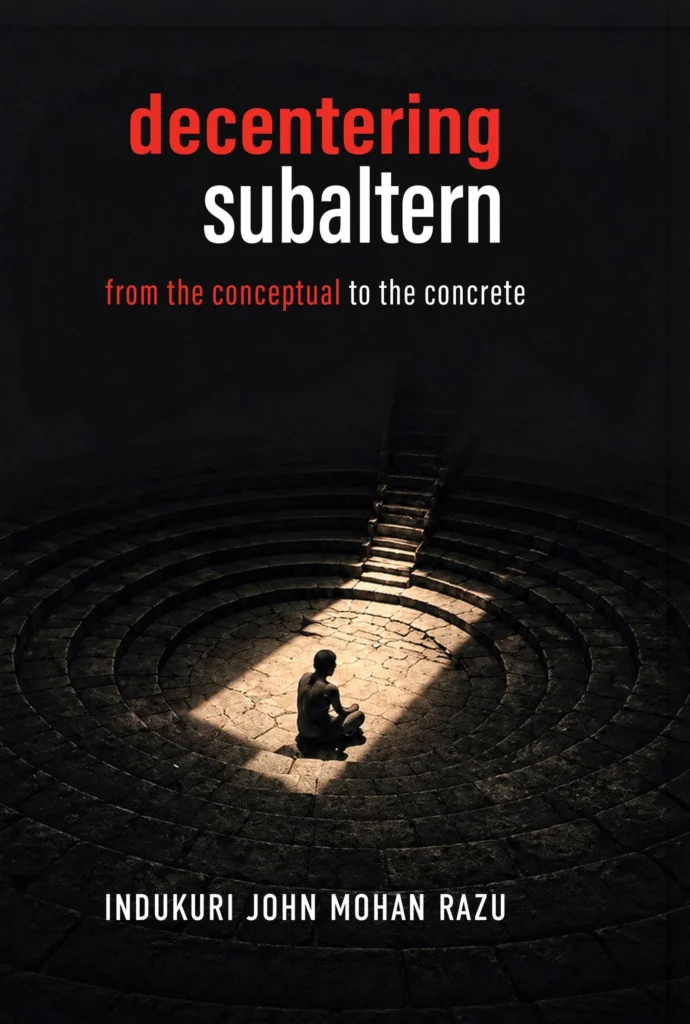
“Unless the caste system is dismantled, an egalitarian, just, humane, and inclusive society is not possible.”
The author has drawn the attention of readers towards subaltern people, a word meaning inferior. The oppressed, marginalized, exploited, and neglected people are victims of the caste system and other social factors. Their challenging situation is neither studied nor documented. However, the author is a firm believer in transformation through education. He also opines that education is not value-free and value-neutral.
Caste system
Caste is definitely a basic structure on which Indian society functions. It is ably supported by Hinduism. Tribals are called vanachals and forest dwellers. They are treated as primitive, uncivilized, backward, uncultured, and illiterate. A person is born into a caste, which is a closed category without exit or upward mobility.
Education system
The author shares that his education was a rough terrain. In Indian universities, knowledge dumping takes place. Only grades are recognized; creativity and other abilities are not rewarded. Hence, he had to de-learn and re-learn. For example, Adam Smith and others delved into wealth-creation economics but did not teach how wealth has been created, at whose expense, and at what cost.
Poverty
Population growth was blamed for poverty. It was not taught that poverty is caused by inequitable distribution of resources, unjust wages, exploitation, financial irregularities, hoarding, and many other factors. The wealthy were mostly from the dominant class, and other castes gave up authority to rule them. The author used the Saul Alinsky method in his intervention ministries.
Pedagogy
The author used a method to understand the context. In the community where he served, 150 words were commonly used. The usage revealed core problems, frustration, anger, resolve, and change. Key words: water (drinking and others), wages, caste, discrimination, oppression, untouchability, equality, representation in politics, land ownership (dwelling and agricultural), and a host of others. He then helped the community become aware and develop consciousness. The issues that emerged were social, economic, cultural, educational, and political.
Risk taking
The author writes: “Theological education taught me one thing in a significant way apart from others that we should be always ready for risking.” (Page 31) A theology of risk-taking is a critical theology. That helped the author to peel the social and economic setting of the subaltern’s layer by layer, and as the layers get cracked off, he developed a theology of risk-taking. His experiences involve disappointments, failures, betrayal, insecurity and loneliness, desperation, exclusion and dejection. The author points out that the Ultimate Risk-taker is the Messiah, the Lord Jesus Christ.
Dalits and faith
The author makes a statement that seems too simple an assumption. He states that Dalits have lived in risky situations for centuries, and what sustained them was their deep-rooted faith in God and total dependence on God, which is pragmatic spirituality. Which God? What faith? The author fails to explain.
Salvation
The author states that God, in his freedom, can save men and women in more ways than one. It contradicts the biblical truth that Jesus is the Only Way, and there is no other name given under heaven among men to be saved.
World order
God’s created order should reflect not domination, but dominion; not feudalism, but relational responsibility; and not a select few, but all humans.
Humans are sinners
Because of Adam and Eve, humanity inherits sin. Unfortunately, the author writes: “The image of God is fractured the moment the so-called ‘rich and powerful’ treat others as sub-humans.” (Page 36)
History
History is an actual event or happening in time and space as the result of human action. The author points out that only the winners or the victorious document history. There is no record of the pain, suffering, and amount of disaster the losers or the defeated experienced. There is always a need to understand the context of aggressors as against the aggrieved. Expansionism, empire-building, and neo-colonial trends could be observed in history. Yet, interpretation of events matters. There are all sorts of perspectives, interpretations, and nuances. All history is violent. Historians present the valour and victories of the dominant and interpret events to suit the powerful. Civilizational revenge on present descendants is dangerous. History is a science: It requires scientific inquiry going deep into the archives, searching and finding out exactly what happened by raising serious questions. Both in secular and sacred histories, there is a certain amount of exaggeration and glorification.
Roman Empire
Rome was ruled with civility, peace, and dignity. Romans considered those outside the Empire barbarians. It had more political conviction than religious conviction. Epicurean philosophy dominated the Empire: a pursuit of sensual pleasure in life, especially food and drink. However, the social condition was slavery and inequality. The author writes that there was an ancient ethical principle: All humans are equal in God’s sight. Apart from the Bible, there is no indication that all humans are equal, a point the author does not emphasize.
Church during Roman Empire
Christianity became the most favoured religion of the Roman Empire (from 325 to 451), beginning with Constantine. Out of seven ecumenical councils, four were held during this time. The author remarks: “Despite the disintegrating society of the 4th and 5th centuries, the church was the only help of the poor and the needy by its charity works, hospitals, homes for the orphans and care for the widows and the poor.” (Page 58) The Middle Ages (590-1073) were termed the Dark Ages because of political campaigns, quarrels, decline of learning, ignorance of clergy, interdependence of secular and religious powers, moral decline, persecution, and superficial conversion. There was intense invasion by Muslims and gradual corrosion of the inner life of the church. The political landscape allowed the Popes to fill the vacuums.
Reformation
The sale of indulgences, centralization, and the papacy's consolidation of authority were some of the reasons for the Protestant Reformation. The Catholic Church responded with the Counter Reformation, an aggressive response to the spread of Protestantism.
Colonialism
The Europeans took advantage of maps. The trade was for precious pearls and spices. Pearls – European invaders exploited the reefs of South America. Empires and colonizers plundered all the raw materials from their colonies and then converted those into products and used the colonies for marketing. Using cheap labor, they built railways, shipyards, infrastructure, and many other developments and advancements.
Dalits and adivasis
They keep struggling for the establishment of human dignity, equality, liberty, fraternity, freedom, fundamental rights, rule of law, social justice, and the establishment of common humanity. Ambedkar suggested the common name for untouchables as Dalits. They are economically poor, socially ostracized, culturally silenced, religiously discriminated against, and politically powerless. Their inferiority is made known to the public in four ways: a contemptible name, not wearing clean clothes, not having a tiled roof, and not wearing silver or gold ornaments. They face rejection, isolation, intimidation, humiliation, and exploitation. Dalits coped with all kinds of shame and humiliation. These could have resulted in emotional disorder, self-condemnation, degradation, non-assertion, anguish, despair, low self-esteem, inferiority complex, loneliness, depression, anger, irritation, and powerlessness.
Fascism
Fascism is a global phenomenon. Fascists use communication technology to spread false narratives and messages. Totalitarian regimes divert attention from basic needs. They have scant respect for the protection and promotion of human rights. With the intention of bringing in a theocratic state: “The casteist forces systematically exercise brute power embedded in the caste-based notion of social hierarchy has been expressed in its ugliest form in recent times.” (Page 276) Christians should be like Bonhoeffer, who challenged Hitler’s regime and was imprisoned and executed.
False news
“Unfortunately, Indian society is filled with fabricated news and is in the midst of conspiracy theories. Democracy should lead we the people from truth to power.” (Page 85) Social media is filled with such fake narratives and false news.
Personalities
The author lists Karl Marx, Ayothidas Pandithar, and B.R. Ambedkar. They understood the subalterns and wrote about them. Marx was a philosopher, economist, historian, political scientist, sociologist, journalist, and revolutionary socialist, committed to the labouring class. Ayothidas Pandithar was an organic intellectual with a clear ideological position and pedagogic rudimentary. He had an interest in Tamil literature, philosophy, and Siddha medicine. He was proficient in English, Sanskrit, and Pali. E.V. Ramaswamy Periyar and B.R. Ambedkar are the inheritors of his legacy. He was Dalit by birth and a Buddhist by conviction. He aspired for egalitarianism within Dravidian Dalit identity. Self-government is possible only when a Brahmana and a pariah can be together, not running away or being chased away by the other. He advocated worshipping non-Brahminic gods and goddesses. Self-respect first, self-identification next, and ultimately self-determination. Ambedkar was a versatile scholar with intellectual acumen, academic rigor, and pragmatism. He believed that the Hindu religion dehumanized the Dalits. The caste system was an obstacle to achieving true justice in India. Social justice was the ultimate goal. He believed in an ideal society based on liberty, equality, and fraternity. One of his great achievements was deciphering and deconstructing hidden motives and demythologizing the content. Once a person is born within the Hindu fold, there is no exit, and he or she must remain in a caste.
Economy
The economy was the base structure on which others, as superstructures, and so economic determination, play most of the entire functions of the nation-states.
Colonialism and caste
Caste was a tool for the British colonizers and Indian casteists. Britain had multiple interests. Portuguese, Spaniards, English, French, and the Dutch came to obtain luxuries, spices, chilies, cloves, and others. “It is worthwhile to note that the First Battle of Plassey in 1757 and the Battle of Koregaon in 1818 (the conquest of India during 1757 and 1818) were predominantly comprised of the Untouchables.” (Page 160) But by 1910, Untouchables disappeared from the Army. Pax Britannica ignored casteism and untouchability, the two social evils. Casteism has been used as a tool of subjugation through internal colonialism by the upper castes.
Manifestations
Five case studies of nefarious manifestations of the caste system have been provided. Ambedkar said: “Hindu society is a house of Castes. Hindus are not a people. They are aggregates of groups of people formed into castes. This is the peculiarity.” (Page 184) In 1947, India banned caste discrimination, but it continues even now at different levels and in different forms, and manifests at alarming levels. Social democracy, economic democracy, and political democracy are needed in India.
Governance
The term governance is being used frequently, cutting across caste, creed, and religion. Governance is a connotation for effective regulation, accountability, transparency, and efficiency as against corrupt, inefficient, and unaccountable governments, bureaucracies, and quasi-governmental agencies. Good governance, according to the UN, means creating an effective political framework conducive to private economic action – stable regimes, the rule of law, efficient state administration, and a strong civil society independent of the state.
Globalization
Global capitalism thus augments competition, demands professionalism, and prefers skilled labour that adds advantage for the upper castes. “Capitalism and casteism fail to meet with equity and equality, respectively.” (Page 222) Capitalism as an economic system cannot destroy caste; instead, it reinforces it.
Peripheral expressions
“It posits the clash of mind-sets-casteist mind-sets Vs anti-casteist mind-sets; clash of oppositional ideology, philosophy, politics- exclusive vs. inclusive, polarizing Vs all-embracing, domesticating Vs liberating, unity in uniformity Vs unity in diversity.” (Page 233)
Solution?
Dalits endure a wall of shame: Dalit leader assaulted for hoisting tricolor, fined for entering temple, we will starve but not eat food cooked by Dalit; cry goes unheard. Unless the caste system is dismantled, an egalitarian, just, humane, and inclusive society is not possible. The Brahminical Hindu fold does not want anyone to escape. Hence, anti-conversion laws have been brought in.
Conclusion
This is a good introductory book for those who wish to learn about subaltern issues from social, political, and economic perspectives. The author’s use of Homo sapiens instead of human beings reveals his rejection of the creation account and acceptance of evolution. His claim that God could save a person in many ways is not a biblical view. The author fails to encourage, envision, and equip the Church to use the spiritual resources given by God to bring transformation.